
MRE Self Heating Bag: How It Works, Uses, Water & Buying Guide
A warm meal is easy when there is a microwave or kitchen nearby.
It becomes a different problem when you’re traveling, camping, spending the day outdoors, or developing a ready-to-eat food product that needs to be heated without conventional equipment.
That’s where an MRE self heating bag comes in.
The basic idea is straightforward: a sealed prepared meal is placed inside a heating bag with a separate water-activated heating pack. Add the specified amount of water, allow the heating reaction to run, and the meal warms without electricity or an open flame.
But a useful heating bag is about more than simply getting hot.
The food weight, packaging, starting temperature, heater size, activation water, and target heating result all matter.
So let’s look at the questions buyers usually ask before choosing one.
What Is an MRE Self Heating Bag?
An MRE self heating bag is a portable bag-and-heater system designed to warm a sealed ready-to-eat meal without electricity, a microwave, or an open flame. The heating pack is activated with a specified amount of water, and the resulting heat transfers through the meal’s packaging.
In food packaging, MRE is commonly used as shorthand for “Meal, Ready-to-Eat.” The self-heating bag is the heating part of the overall meal system.
The food remains inside its own sealed pouch or container.
The heater remains separated from the food.
The basic sequence is:
Meal + heating pack → add water → heat generated → food warmed
For commercial applications, JOYTIDE provides flameless ration heater solutions as well as different heating bag configurations for compatible ready-to-eat meal products.
How Does an MRE Self Heating Bag Work?
An MRE self heating bag works by using water to activate a heating material inside a separate heater pack. The activation starts an exothermic reaction, which releases heat. That heat passes through the food package and warms the prepared meal.
The process does not require an electrical heating element.
It also does not rely on an open burner.
The heating material stays inside the heater pack while the food remains sealed in its own packaging.
This physical separation is important.
A properly designed system is not intended to mix the heater material with the meal. Instead, the heater provides thermal energy from outside the food package.
조이타이드의 magnesium-based flameless heater uses a water-activated heating system for compatible sealed ready-to-eat meals and can be evaluated according to the meal weight, package dimensions, and target heating requirements.
Does an MRE Self Heating Bag Need Electricity?
No. A water-activated MRE self heating bag normally does not need electricity during use. The heating pack generates heat after the specified amount of water is added, making it suitable for portable meals where a microwave, outlet, or conventional stove is inconvenient.
That is one of the main reasons people use this type of system.
You can carry the meal and heater together instead of depending on a kitchen.
For civilian applications, that can include:
- 캠핑
- 하이킹
- 로드 트립
- 피크닉
- Travel meals
- 야외 작업
- 즉석식품
- 가정 비상 대비
A self-heating bag is more specialized than a stove, though.
A stove is designed for cooking.
A heating bag is primarily designed to 따뜻하게 조리된 음식.
How Much Water Does an MRE Self Heating Bag Need?
There is no universal water quantity for every MRE self heating bag. The correct amount depends on the heater’s formulation, size, and activation design. Always use the amount specified for the selected heater rather than copying the instructions from another product.
This is a small detail that can have a surprisingly big effect on the user experience.
Too little water may prevent the heater from activating as intended.
Adding more water doesn’t automatically mean the food will become hotter.
For commercial products, the activation method should be as simple as possible. A marked fill line or clearly printed instruction can help prevent customers from guessing.
조이타이드의 무화염 히터 자주 묻는 질문 also explains that activation-water requirements depend on the selected heater model.
How Long Does an MRE Self Heating Bag Take to Heat Food?
Heating time depends on the heater, meal weight, starting temperature, food thickness, packaging, activation water, and ambient conditions. There is no single heating time that applies to every self-heating meal.
This is one of the most important points for commercial buyers.
A 250 g rice meal at room temperature is not the same heating challenge as a 500 g stew that starts cold.
Even two meals with the same net weight can behave differently if one is in a thin pouch and the other is in a deep container.
A useful test therefore records several points rather than only one final number.
| Test Point | 무엇을 기록해야 할까요? |
|---|---|
| 시작 조건 | Food temperature before activation |
| 히터 | Exact heater model |
| 물 | 활성화 수량 |
| 음식 무게 | Net meal weight |
| 포장 | Pouch, tray, or container |
| 5 minutes | Food temperature |
| 10 minutes | Food temperature |
| 15 minutes | Food temperature |
| 최종 결과 | Overall heating performance |
For commercial development, this produces much more useful information than saying simply, “Heats in 10 minutes.”
How Hot Does an MRE Self Heating Bag Get?
The heater and the food do not necessarily reach the same temperature. A heating pack may become hotter than the meal because some heat is transferred through the packaging and some is lost to the surrounding environment.
That distinction matters.
If a supplier says the heater can reach a certain temperature, that number doesn’t automatically tell you what temperature the food will reach.
For the finished meal, it is more useful to measure the temperature of the actual food.
For thicker meals, measure more than one location.
The part closest to the heater may warm faster than the center.
This is why a good development test looks at both temperature and temperature distribution.
What Foods Can an MRE Self Heating Bag Warm?
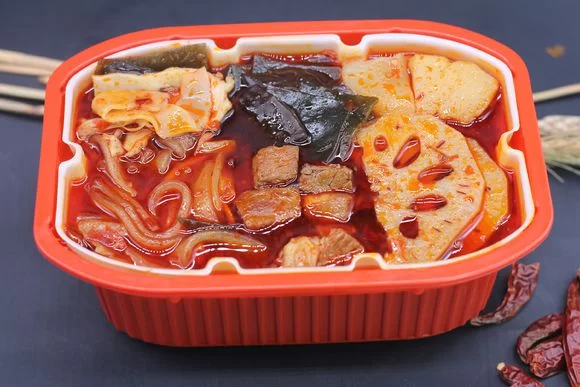
An MRE self heating bag can be designed for compatible prepared foods such as rice, noodles, pasta, soups, stews, hot pot products, and other sealed ready-to-eat meals. Compatibility depends on the food weight, package shape, material, starting temperature, and heater configuration.
For example, consider two 400 g meals.
One is a flat rice pouch.
The other is a deep container filled with thick soup.
They weigh the same, but the heat does not have to travel through the food in the same way.
This is why suppliers need more information than simply the food weight.
For tray-based meals, JOYTIDE also supplies 자체 발열 식품 용기 및 도시락 designed for compatible rice, noodles, soups, hot pot products, and other prepared meals.
Can an MRE Self Heating Bag Heat Refrigerated Food?
A suitable self heating bag may be able to warm refrigerated prepared food, but the colder starting temperature increases the heating requirement. For commercial products, the heater and meal should be tested from the actual temperature expected during customer use.
This is especially important if the meal is intended to move directly from refrigerated storage into the heating system.
Don’t test the product at room temperature and use that result to represent refrigerated use.
The food package matters here too.
The U.S. Food and Drug Administration identifies different conditions of use for food-contact substances, including frozen or refrigerated ready-prepared foods intended to be reheated in their containers at the time of use. Its 식품 종류 및 식품 접촉 물질의 사용 조건 is a useful reference when evaluating packaging for a reheatable food product.
For a commercial meal, therefore, think about:
heater + food + packaging + starting temperature
rather than choosing a heater independently.
가열 장치가 음식에 닿습니까?
No. In a properly designed MRE self heating bag system, the heating material stays inside its own heater pack while the food remains inside a separate sealed pouch, tray, or container. Heat transfers through the packaging rather than by mixing the heater material with the meal.
This separation is a basic part of the system.
The typical arrangement is:
발열체 → 히터팩 → 식품 포장 → 식품
That is also why the food package cannot be treated as an afterthought.
For U.S.-market products, FDA’s guidance on food packaging and substances that come in contact with food explains that intended use and conditions of use are relevant when evaluating food-contact materials.
A package being described generally as “food grade” isn’t the end of the discussion when the product will experience a specific heating condition.
Is an MRE Self Heating Bag Safe?
A self heating bag is designed to generate heat, so it should be handled according to its specific instructions. “Flameless” means the system does not use an open flame; it does not mean the heating compartment, water, or vapor remains cool during operation.
Basic precautions are straightforward:
- Use only the specified amount of water.
- Keep the heating material away from the food.
- Never open or consume the heating material.
- Do not drink the activation water.
- Keep the system on a stable surface.
- Keep any intended steam or venting path clear.
- Avoid touching the heating compartment while it is hot.
- Handle the heated food package carefully.
- 사용한 히터는 버리기 전에 완전히 식히십시오.
- Follow the manufacturer’s instructions.
For commercial products, the instructions should be designed around the actual product configuration rather than copied from a different heater.
Can You Use Hot Water Instead of Cold Water?
Do not assume that hot water will make a water-activated heating pack work better or faster. Use the activation method specified for the selected heater. Changing the water temperature or amount can alter the intended operating conditions.
This is one of those situations where experimenting isn’t particularly useful.
If the product instructions specify a particular activation process, keep it consistent.
For product development, this also makes testing easier because every sample starts under the same conditions.
Can an MRE Self Heating Bag Cook Raw Food?
A typical MRE self heating bag is intended to warm prepared food rather than cook raw ingredients. Unless the complete system has specifically been designed and validated for cooking the particular raw food involved, it should not be treated as a replacement for conventional cooking equipment.
There is an important difference between:
미리 준비된 음식을 데우는 것
그리고
cooking raw food safely.
A ready-to-eat rice or noodle meal is one type of application.
Raw meat or other uncooked ingredients require controlled cooking conditions and sufficient heating throughout the product.
For most portable food-heating systems, the safer and clearer product positioning is:
Prepared meal → warm meal
오히려:
Raw ingredients → cooked meal
Can an MRE Self Heating Bag Be Reused?
Most water-activated heating packs are designed for a single heating cycle. After the reaction is complete, adding water again does not restore the heater’s original heating capacity.
For consumers, this means the used heater should normally be treated as a consumable component of the meal system.
After operation, allow it to cool and follow the product’s disposal instructions.
For food manufacturers, this also means each individual meal normally requires its own compatible heating pack.
자체 발열 백을 사용하면 식품을 상온 보관할 수 있나요?
No. A self heating bag only provides heat; it does not make food shelf-stable. A meal’s storage life depends on how the food has been processed, packaged, and stored.
This distinction is particularly important when developing commercial food products.
A refrigerated prepared meal doesn’t become shelf-stable simply because a heating pack is included.
USDA explains that shelf-stable foods can rely on specific processing and packaging methods. For example, USDA’s Shelf-Stable Food Safety guidance describes retort pouches as flexible packages used with foods that undergo commercial thermal processing.
So think of the two components separately:
Food processing determines storage.
The heater provides heat.
One does not replace the other.
What Is the Difference Between an MRE Self Heating Bag and a Food Heating Pack?
An MRE self heating bag is a complete bag-style heating setup designed around a ready-to-eat meal, while a food heating pack usually refers specifically to the water-activated heater component. The two terms can overlap depending on the product configuration.
For sourcing purposes, it helps to know which component you actually need.
If you already have the meal pouch and only need the heater, you may be looking for a food heating pack.
If you need the outer bag, heater, instructions, and meal positioning together, you’re looking at a more complete self-heating bag system.
조이타이드 용품 aluminum-based heating packs 그리고 magnesium-based heating solutions for different food-heating applications.
MRE Self Heating Bag vs. Portable Stove
The two systems solve different problems.
| Feature | MRE Self Heating Bag | 휴대용 스토브 |
|---|---|---|
| Electricity | Not normally required | Not normally required |
| 불꽃 | 아니요 | Usually |
| Prepared meals | Well suited | 예 |
| Raw ingredients | Not normally its purpose | 예 |
| Cookware | 대개 불필요함 | Usually required |
| 설정 | Simple | More equipment |
| Cleaning | 최소 | Usually required |
| Portability | 높은 | Depends on stove and fuel |
| Main purpose | Warm prepared food | Cook or heat food |
If you’re preparing a meal from scratch, a stove is more flexible.
If you’ve already got a packaged meal and want to warm it with minimal equipment, a self-heating bag is designed around that use case.
Why Doesn’t One Self Heating Bag Work for Every Meal?
Different meals require different amounts of heating energy because food weight, thickness, starting temperature, packaging, and composition all affect heat transfer. A heater that works well for one meal should not automatically be assumed to work equally well for another.
This is why “one heater for everything” is usually not a useful commercial specification.
Take a 300 g flat rice pouch and a 300 g deep soup container.
The food weight is identical.
The thermal path is not.
That difference can affect the heating time and final temperature.
A good supplier should therefore ask what you’re actually heating before recommending a configuration.
What Should I Look for When Buying an MRE Self Heating Bag?
The right MRE self heating bag should be selected according to the actual meal rather than heater weight alone. Consider food weight, package dimensions, starting temperature, target heating result, activation method, customization needs, and test data before placing a bulk order.
A useful checklist looks like this:
Food Weight
Give the exact net weight per serving.
Food Type
Rice, noodles, soup, stew, pasta, hot pot, or another prepared meal?
패키지
Flexible pouch, rigid tray, bowl, or divided container?
Package Dimensions
Actual dimensions are much more useful than a general description.
Starting Temperature
실온인가요?
냉장 보관?
Another controlled condition?
Target Heating Result
Define the desired serving temperature rather than simply saying “hot.”
Heating Time
Specify the preparation window you want to achieve.
수량
Include both sample quantity and estimated production volume.
Destination Market
Different markets can have different packaging, labeling, and documentation requirements.
Should I Choose the Heaviest Heater?
Not necessarily. A heavier heating pack may provide greater heating capacity, but the largest heater is not automatically the best choice for every meal. Heater selection should be based on the complete food-heating system and confirmed through testing.
This is one of the most common sourcing mistakes.
Imagine three heaters:
40 g
50 g
60 g
It would be easy to assume the 60 g version must be the best.
But that doesn’t tell you whether it fits the food package properly, whether it produces the desired result, or whether the additional capacity is even needed.
The better process is:
Define the meal → select a candidate heater → test → measure → adjust → confirm
That’s far more reliable than choosing purely by heater weight.
What Should a Food Brand Test Before Bulk Production?
A commercial buyer should test the actual food, actual package, and proposed heater together under realistic starting conditions before approving bulk production. Heating time, food temperature, temperature distribution, packaging performance, activation, instructions, and consistency should all be checked.
A practical sample test can include:
| Test Area | 확인해야 할 사항 |
|---|---|
| Activation | Is adding the water straightforward? |
| 가열 시간 | Does the meal warm within the intended period? |
| Food temperature | Does the meal reach the target result? |
| Heat distribution | Is the center warm enough? |
| 포장 | Does the pouch or tray tolerate heating? |
| Handling | Is the meal easy to remove? |
| 지침 | Can a first-time user understand them? |
| Consistency | Do multiple samples perform similarly? |
Testing an empty container or a cup of water is not a substitute for testing the actual meal.
The finished product should be tested as a complete system.
Does the Food Package Need to Be Special?
The food package should be suitable for the food and the intended heating conditions. A package that works for ordinary storage should not automatically be assumed to be suitable for every reheating application.
This is particularly important for commercial products.
FDA’s published conditions of use distinguish between room-temperature storage, refrigerated storage, frozen storage, and ready-prepared foods that are reheated in the container at the time of use.
So when selecting a food pouch or tray, don’t ask only:
“"이거 식용 등급인가요?"”
Ask:
“"이 포장재는 우리가 계획한 가열 조건에서 해당 식품에 적합한가요?"”
That is a much better product-development question.
What Information Should You Send a Supplier?
A supplier can recommend a much more suitable heater when the inquiry contains actual meal information.
Instead of sending:
“Please quote MRE self heating bag.”
send something like:
“We need a self-heating bag for a 400 g prepared rice meal in a flexible pouch. The product starts at room temperature and needs to reach our target serving temperature within a defined heating period.”
That’s enough information to start a real discussion.
You can also provide:
| 프로젝트 상세 정보 | Example |
|---|---|
| 음식 | Prepared rice meal |
| Weight | 400 g |
| 패키지 | Flexible pouch |
| 치수 | Actual pouch size |
| 시작 온도 | Room temperature |
| Target | Defined food temperature |
| 가열 시간 | Preferred preparation period |
| 시장 | Destination country |
| 수량 | Sample + estimated bulk order |
| 맞춤 설정 | Printing / private label / instructions |
For a new product, photos or packaging drawings can also be useful.
Can an MRE Self Heating Bag Be Customized?
Yes. Commercial self-heating bag projects may be customized according to meal size, heater configuration, heating capacity, bag dimensions, printed instructions, private-label packaging, and packing requirements. The available options depend on the confirmed product and order quantity.
조이타이드의 조이타이드를 선택해야 하는 이유 page describes customization options such as heater dimensions, heating capacity, compartment structure, outer bags, printed instructions, private-label packaging, and bulk packing.
The important point is that customization should start with the food.
A good development sequence is:
Food → food package → heater → outer heating bag → instructions → retail packaging
That prevents packaging decisions from being made before the actual heating requirements are known.
Why Sample Testing Matters More Than a Specification Sheet
A specification sheet can tell you the heater’s designed parameters.
It can’t tell you exactly how your meal will behave.
That’s why sample testing is so important.
Imagine a supplier says the heater reaches a certain temperature.
That’s useful.
But your real questions are:
Does my food heat properly?
Does the center warm enough?
Does the pouch remain intact?
Is the heating time practical?
Can customers understand the activation instructions?
Do repeated samples behave consistently?
Those questions tell you whether the system actually works for the product you intend to sell.
A Practical Way to Develop an MRE Self Heating Bag Product
For a commercial food brand, the simplest development process is usually to start with the meal.
Step 1: Define the food.
What are you heating?
Step 2: Confirm the serving weight.
How many grams are in one package?
Step 3: Confirm the package.
Pouch, bowl, tray, or another format?
Step 4: Define the starting temperature.
Room temperature or refrigerated?
Step 5: Define the target.
How warm should the meal become?
Step 6: Test a proposed heater.
Use the actual meal.
Step 7: Measure the result.
Check multiple points where appropriate.
Step 8: Adjust the configuration.
Change the heater or packaging if needed.
Step 9: Repeat the test.
Confirm performance across multiple samples.
Step 10: Approve the final configuration.
Only then move toward bulk production.
It may take more than one sample round.
That’s normal.
The goal isn’t to find the hottest heater.
The goal is to find a heater that works consistently with the actual meal.
Frequently Asked Questions
What does MRE mean in MRE self heating bag?
MRE commonly stands for Meal, Ready-to-Eat. In a self-heating product, the heating bag provides the heat needed to warm a compatible prepared meal.
What is an MRE self heating bag?
It is a portable heating bag system that uses a water-activated heating pack to warm a sealed ready-to-eat meal without electricity or an open flame.
Does an MRE self heating bag need electricity?
No. Water-activated heating systems generate heat without an electrical outlet during normal use.
물을 얼마나 넣어야 할까요?
The correct quantity depends on the selected heater. Always follow the instructions supplied for that particular model.
How long does an MRE self heating bag take?
Heating time depends on the heater, food weight, starting temperature, package shape, activation water, and ambient conditions.
What food can it heat?
Compatible prepared meals may include rice, noodles, soups, stews, pasta, hot pot, and other ready-to-eat packaged foods.
냉장 보관된 음식을 데울 수 있나요?
A suitable configuration may be able to heat refrigerated prepared food, but testing should reproduce the actual starting temperature expected during use.
히터가 음식에 닿나요?
No. The heating material remains inside its own pack and should stay physically separated from the food.
Is an MRE self heating bag reusable?
Most water-activated heating packs are designed for one heating cycle.
Can it cook raw food?
Typical systems are intended to warm prepared food rather than cook raw ingredients.
Does the heating bag make food shelf-stable?
No. Food shelf stability depends on processing, packaging, and storage conditions, not on the presence of a heating pack.
Can the heating bag be customized?
Commercial projects may allow customization of heater size, heating capacity, outer bag, packaging, instructions, and private-label elements.
샘플을 요청할 수 있나요?
Sample testing can be used to evaluate the heater, meal package, activation method, and heating performance before bulk production.
What information should I provide when requesting a quotation?
Provide the food type, meal weight, package dimensions, starting temperature, target heating result, preferred heating time, destination market, estimated quantity, and customization requirements.
Looking for an MRE Self Heating Bag for Your Food Product?
Choosing an MRE self heating bag should start with the meal, not simply the heater.
Tell your supplier:
What food are you heating?
How much does one serving weigh?
What package are you using?
What temperature does the meal start at?
How warm should it become?
How quickly should it heat?
With that information, the heater can be selected and tested according to the actual product.
조이타이드 용품 flameless ration heaters, magnesium-based heating packs, aluminum heating packs, and 자체 발열 식품 용기 호환 가능한 즉석식품의 경우.
새로운 프로젝트를 위해, 조이타이드에 문의하세요 with your meal specifications, packaging details, target heating result, destination market, and estimated order quantity to discuss sample testing and a suitable configuration.

 English
  German
  French
  Korean
  Japanese
  Russian
  Arabic
  Portuguese
  Spanish