
A 무화염 배급용 히터 is a simple idea with a surprisingly wide range of applications.
Add the specified amount of water, activate the heating pack, place the compatible prepared meal in the designated heating area, and wait for the food to warm.
No electrical outlet.
No stove.
No open flame.
For consumers, that’s convenient. For food companies, however, choosing the right heater involves considerably more than finding a pack that gets hot.
The food weight, package shape, starting temperature, heater specification, activation water, and target serving temperature all affect the final result.
So before choosing a flameless heater, it’s worth answering the questions that actually matter.
What Is a Flameless Ration Heater?
A 무화염 배급용 히터 is a portable heating component designed to warm a compatible sealed prepared meal without electricity or an external cooking appliance. Water activates the heating material inside the pack, creating an exothermic reaction that releases heat and transfers it through the food packaging.
The heater material stays separate from the food.
The basic principle is straightforward:
Add water → activate the heater → heat is generated → heat transfers to the meal → the prepared food is warmed.
Although the term “ration heater” is widely associated with packaged meal systems, the same type of water-activated heating technology can be used for civilian ready-to-eat food products, outdoor meals, travel food, and other portable meal applications.
조이타이드의 무화염 배급용 히터 solutions can be configured for compatible food pouches and self-heating meal systems.
How Does a 무화염 식량 가열기 Work?
A water-activated flameless heater generates heat through a chemical reaction that begins when the specified amount of water reaches the heating composition.
The heat is produced inside the heater pack rather than by combustion or an electrical heating element.
The prepared meal remains sealed in its own pouch or container. Heat then passes through the package and warms the food.
That sounds simple, but the actual performance depends on how the heater, food, and packaging are designed together.
This is why the same heater may perform differently with two meals that have the same weight but different package shapes.
Does a Flameless Ration Heater Need Electricity?
No. A water-activated 무화염 배급용 히터 does not normally require an electrical connection during use.
Instead, the heating material produces heat after being activated with the specified amount of water.
This makes the system useful when conventional kitchen equipment isn’t convenient or available.
For example, a prepared meal can be designed around a portable heating pack for:
- 캠핑
- 하이킹
- Outdoor recreation
- 로드 트립
- 피크닉
- Travel meals
- 야외 작업
- 즉석식품
- 가정 비상 대비
The important distinction is that a flameless heater is primarily a meal-warming system. It isn’t intended to replace a full cooking setup in every situation.
How Much Water Does a Flameless Ration Heater Need?
There is no universal amount of water that works for every flameless ration heater. The correct amount depends on the specific heater model, formulation, size, and activation design.
Use only the amount stated in the product instructions.
Adding more water does not automatically produce more useful heat, and using less water can affect activation and heating performance.
조이타이드의 무화염 히터 자주 묻는 질문 also recommends using the specified activation-water quantity for the selected model rather than assuming different heater packs use the same amount.
For consumer products, a printed fill line can make activation easier because the customer doesn’t need to measure the water precisely.
How Long Does a Flameless Ration Heater Take to Heat Food?
A flameless ration heater does not have one universal heating time. The result depends on the heater, food weight, starting temperature, package design, activation water, and surrounding conditions.
For a commercial food product, heating time should therefore be tested using the actual meal and packaging.
A typical test might record:
Starting temperature → 5 minutes → 10 minutes → 15 minutes → final food temperature
This is much more useful than simply advertising one heating time without explaining the conditions behind it.
What Can Change Heating Time?
Several variables can make a noticeable difference.
| 요인 | Effect |
|---|---|
| Meal weight | Larger meals generally require more heating energy |
| 음식 두께 | Deep meals may take longer to warm at the center |
| 시작 온도 | Colder food requires a greater temperature increase |
| 히터 사양 | Different heater sizes and formulations perform differently |
| 물의 양 | Correct activation is important for consistent operation |
| Package shape | Changes the distance heat must travel |
| Package material | Affects heat transfer |
| 주변 온도 | 추운 환경은 열 손실을 증가시킬 수 있습니다. |
This is why a supplier should ideally provide test conditions along with heating-performance data.
How Hot Does a 무화염 식량 가열기 얻다?
The heater itself and the food do not necessarily reach the same temperature.
A heating pack can become much hotter than the final meal because the heat is transferred through packaging and some energy is lost to the surrounding environment.
For the end user, the more useful measurement is therefore the 음식 온도, not simply the maximum heater temperature.
For product development, it can be useful to measure different parts of the meal.
The area directly above the heater may become warm quickly, while the center of a thick meal takes longer.
A good test should therefore look at heating distribution as well as the maximum temperature reached.
What Foods Can a Flameless Ration Heater Warm?
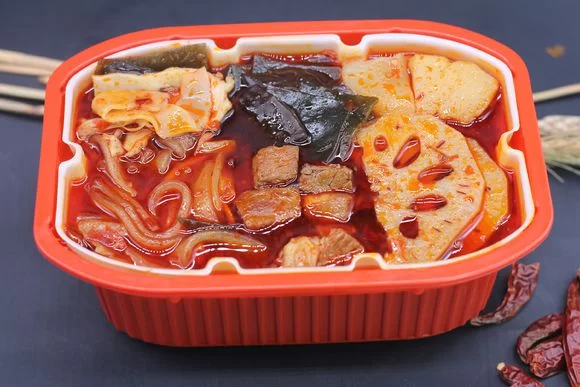
A compatible flameless heater can be used with many types of prepared foods, including rice meals, noodles, pasta, soups, stews, hot pot products, prepared dishes, and ready-to-eat food pouches.
However, food type alone does not determine compatibility.
Consider two meals:
350 g flat rice pouch
그리고
350 g deep soup container
They have the same net weight.
Their heating requirements can still be very different.
Food thickness, moisture content, package dimensions, and the distance between the heater and the food all influence how heat moves through the meal.
For tray-based meals, JOYTIDE’s 자체 발열 식품 용기 및 도시락 are another option for compatible rice, noodles, soups, hot pot products, and prepared meals.
Can a Flameless Heater Warm Refrigerated Food?
It can be possible, but refrigerated meals require more heating energy than meals starting at room temperature, so the heater should be tested under the actual expected starting condition.
This is especially important for commercial food products.
If the finished meal is intended to go directly from refrigerated storage into the heating system, samples should be tested that way.
The package must also be suitable for its intended heating conditions.
The U.S. Food and Drug Administration distinguishes food-contact materials according to their intended conditions of use, including refrigerated or frozen ready-prepared foods intended to be reheated in their containers. The FDA’s 식품 종류 및 식품 접촉 물질의 사용 조건 provides a useful reference when evaluating packaging for a reheatable food product.
That leads to an important sourcing rule:
test the heater and the food package together.
가열 장치가 음식에 닿습니까?
No. In a properly designed flameless meal-heating system, the heating material remains inside its own heater pack and stays physically separated from the food.
The food remains inside a sealed pouch, tray, or container.
The heater remains in a separate heating area.
Heat travels through the packaging rather than requiring the heater material to contact the meal.
This separation is a basic part of the system design.
For commercial food products, packaging should also be evaluated according to its actual intended use. FDA’s information on food packaging and substances that come in contact with food explains the broader food-contact framework used in the United States.
So don’t evaluate the heating pack in isolation.
Evaluate:
heater + food package + food + heating conditions
as one system.
Is a Flameless Ration Heater Safe?
A properly designed flameless heater is intended to warm compatible food without an open flame, but it still produces substantial heat and should be used according to its instructions.
“Flameless” describes the heating method.
It does not mean the system stays cool.
During activation, users may encounter hot surfaces, heated water, and vapor. The heater should therefore be placed on a stable surface and handled carefully.
Basic precautions include:
- 지정된 활성화수만 사용하십시오.
- Keep the heater material separate from the food.
- Never open or consume the heater material.
- Do not consume the activation water.
- Keep the heating system stable during operation.
- Avoid contact with hot surfaces.
- Keep any required ventilation path clear.
- Handle the heated food package carefully.
- 사용한 히터는 버리기 전에 완전히 식히십시오.
- Follow the specific instructions supplied with the heater.
The exact safety requirements can vary between heater designs, so product-specific instructions should always take priority.
Can You Use Hot Water to Activate a Flameless Heater?
Do not assume that hotter water will make the heater work better.
Unless the manufacturer specifically instructs you to use hot water, use the activation method specified for the particular heater.
The heating reaction is designed around certain operating conditions.
Changing the water temperature or quantity can change how the system behaves.
For a commercial product, this is another reason clear instructions matter.
A customer should not have to experiment with the activation process.
Can a Flameless Ration Heater Cook Raw Food?
A typical 무화염 배급용 히터 is designed to 따뜻하게 조리된 음식, not to function as a general-purpose cooking appliance.
That distinction is important.
Cooking raw ingredients can require controlled internal temperatures and sufficient heating throughout the food.
A portable heater designed for prepared meals should not automatically be assumed to provide those conditions.
Unless a complete heating system has been specifically designed and validated for cooking a particular raw food, its intended application should remain warming compatible prepared meals.
Can a Flameless Ration Heater Be Reused?
Most water-activated heating packs are designed for a single heating cycle.
After activation, the heating reaction consumes the reactive materials, so adding water again does not restore the original heating capacity.
For that reason, these heaters are generally treated as consumable components of the meal-heating system.
After use, allow the heater to cool and follow the disposal instructions for the specific product and destination market.
Does a Flameless Heater Make Food Shelf-Stable?
No. A 무화염 배급용 히터 warms the meal, but it does not preserve the food or change its storage requirements.
Whether a food product is shelf-stable depends on its processing, packaging, and storage conditions.
USDA explains that products such as retort pouches become shelf-stable through appropriate commercial thermal processing and packaging. The USDA guidance on shelf-stable food safety provides additional information about how processing and packaging relate to shelf stability.
So a meal that requires refrigeration does not become shelf-stable simply because it contains a heating pack.
Keep these two functions separate:
Food processing determines storage.
The heating pack provides heat.
Why Doesn’t One Flameless Heater Work for Every Meal?
Because heating a meal isn’t the same as heating a metal plate.
The food itself determines how heat moves.
A thin pouch of rice may warm differently from a deep container of soup.
A room-temperature meal may warm differently from a refrigerated meal.
A 250 g serving may have very different requirements from a 500 g serving.
This is why a commercial heater shouldn’t be selected purely by pack weight.
Instead, look at:
meal weight + food structure + package + starting temperature + target result
Then select and test the heating pack.
How Do You Choose the Right Flameless Ration Heater?
The right heater is the one that matches the actual meal and packaging rather than the heater with the largest temperature number.
Start by defining the product.
Meal Weight
Tell the supplier the actual net food weight per serving.
Food Type
Rice, noodles, soup, stew, pasta, hot pot, or another prepared meal?
Package Dimensions
Provide the actual pouch or container dimensions.
Starting Temperature
Will customers use the meal at room temperature or directly from refrigeration?
Target Heating Result
Define what you mean by “hot.”
For a commercial project, specify a measurable target temperature and a reasonable preparation window.
Intended Use
Outdoor meal?
Travel food?
Retail ready-to-eat product?
Private-label self-heating meal?
The application can influence the appropriate packaging format.
Order Quantity
Sample quantity and estimated production volume both help a supplier understand the project.
What Should a Food Company Test Before Ordering in Bulk?
This is where the difference between a sample that “gets hot” and a useful commercial product becomes obvious.
Don’t test the heater alone.
Test the actual meal.
Use the intended package.
Start from the expected customer starting temperature.
Then measure the result.
A practical evaluation can include:
| Test | 확인해야 할 사항 |
|---|---|
| Activation | Is the water amount easy to understand? |
| 가열 시간 | How quickly does the food warm? |
| Food temperature | Does the meal reach the intended result? |
| Temperature distribution | Is the center warm enough? |
| 포장 | Does the pouch or tray tolerate heating? |
| Handling | Can the customer remove the meal safely? |
| 지침 | Can a first-time user understand the process? |
| Consistency | Do multiple samples behave similarly? |
For a U.S.-market food product, the packaging evaluation should also take into account the intended conditions of use identified by FDA for food-contact applications.
What Information Should You Send a Supplier?
A supplier can give you much more useful feedback when you provide actual product information.
Instead of sending:
“Please quote flameless ration heater.”
send:
“We need a heater for a 400 g rice meal in a 220 × 160 mm pouch, starting from room temperature, with a target serving temperature within a defined heating time.”
That’s already a real project.
Useful information includes:
| 프로젝트 상세 정보 | Example Information |
|---|---|
| 음식 | Rice meal |
| 순중량 | 400 g |
| 패키지 | Flexible pouch |
| 치수 | Actual dimensions |
| 시작 온도 | Room temperature |
| Target | 권장 서빙 온도 |
| 가열 시간 | 권장 준비 기간 |
| 시장 | Destination country |
| 수량 | Sample + expected bulk volume |
| 맞춤 설정 | 인쇄된 가방, 사용 설명서, 개인 라벨 |
조이타이드의 조이타이드를 선택해야 하는 이유 page explains its approach to product selection, sample evaluation, customization, packaging, production control, and documentation support.
Can Flameless Ration Heaters Be Customized?
Yes. Depending on the project, heater weight, dimensions, heating capacity, outer bag, packaging arrangement, printed instructions, and other specifications may be customized.
조이타이드의 마그네슘 기반 무화염 식량 가열기 can be evaluated according to meal weight, package dimensions, starting temperature, and target heating requirements.
The company also offers different heater and self-heating container configurations for prepared food applications.
Customization may include:
- 히터 크기
- Heater weight
- Heating capacity
- Outer heating bag
- 포장 구조
- 인쇄된 지침
- 자체 브랜드 포장
- Inner food tray
- Container dimensions
- Packing configuration
However, customization should start with the meal.
The heater should fit the food product—not the other way around.
Why Sample Testing Matters Before Bulk Production
A specification sheet can tell you what a heating pack is designed to do.
It can’t tell you exactly how your meal will behave until the two are tested together.
A proper sample test should answer questions such as:
Does the whole meal warm sufficiently?
Does the center remain noticeably cooler?
Does the package tolerate the heating conditions?
Is the heating time practical?
Can a first-time customer understand the instructions?
Do several samples produce consistent results?
These are much more useful questions than simply asking how hot the heating pack itself can become.
A Simple Way to Develop a Self-Heating Meal
For a new food product, the development process can be surprisingly straightforward.
Start with the food.
Then confirm the portion size.
Choose the food package.
Define the starting temperature.
Define the target heating result.
Select a proposed heater.
Test the actual meal.
Measure the result.
Then adjust the heater or packaging if necessary.
This process may require several sample rounds.
That’s normal.
The goal is not to find the hottest heater.
The goal is to find a heating system that works consistently with the actual meal.
Frequently Asked Questions
What is a flameless ration heater?
A flameless ration heater is a portable heating pack that warms compatible prepared food after activation with a specified amount of water, without requiring electricity or an open flame.
How does a flameless ration heater work?
Water activates the heating material inside the pack, creating an exothermic reaction that releases heat. The heat transfers through compatible packaging to warm the prepared meal.
화염 없는 휴대용 배급용 히터는 전기가 필요합니까?
No. Water-activated models generate heat without an electrical connection during normal operation.
How much water does a flameless ration heater need?
The required amount depends on the specific heater. Always follow the activation instructions for that model.
How long does a flameless ration heater take?
Heating time depends on the heater, food weight, starting temperature, package structure, water quantity, and ambient conditions.
What food can a flameless ration heater warm?
Compatible prepared foods may include rice, noodles, soups, stews, pasta, hot pot products, and other sealed ready-to-eat meals.
냉장 보관된 음식을 데울 수 있나요?
A suitable heater may be able to warm refrigerated meals, but colder starting temperatures require more heating energy. The actual food and package should be tested together.
히터가 음식에 닿나요?
No. The heating material should remain physically separated from the food inside its own heating pack.
Can it cook raw food?
Typical flameless meal heaters are intended to warm prepared food rather than cook raw ingredients.
발열팩은 재사용할 수 있나요?
Most water-activated heating packs are designed for one heating cycle.
Does a flameless heater make food shelf-stable?
No. Shelf stability depends on food processing, packaging, and storage conditions. The heater only provides heat.
Can the heater be customized?
Depending on the project, heater size, weight, heating capacity, packaging, printed instructions, and private-label options may be customized.
샘플을 요청할 수 있나요?
Yes. Sample testing can be used to evaluate heater and food-package compatibility before bulk production.
견적을 받으려면 어떤 정보가 필요합니까?
Provide the food type, meal weight, package dimensions, starting temperature, desired heating result, destination market, estimated quantity, and customization requirements.
Looking for a Flameless Ration Heater for Your Food Product?
The most reliable way to choose a 무화염 배급용 히터 is to start with the meal rather than the heater.
Tell your supplier:
What is the food?
How much does one serving weigh?
What package are you using?
What temperature does it start at?
How warm should it become?
How quickly should it heat?
With those details, a suitable heating configuration can be selected and tested more accurately.
조이타이드 용품 flameless ration heaters, magnesium-based heating packs, aluminum heating packs, and 자체 발열 식품 용기 호환 가능한 즉석식품의 경우.
새로운 프로젝트를 위해, 조이타이드에 문의하세요 with your meal specifications, packaging details, target heating result, destination market, and estimated quantity to discuss sample testing and a suitable heating configuration.

 English
  German
  French
  Korean
  Japanese
  Russian
  Arabic
  Portuguese
  Spanish